***


posted by Druid Morrigan Conway | 11:56 AM
|
0 Comments


SAVE THIS EARTH! I am not in A.L.F., I.L.F., E.L.F., Sea Shepherds nor any other group... but I believe, with every breath I take, that what the groups are doing IS THE WAY TO BE * TO HELP SAVE HUMANITY. "I Am What I Am & That's All That I Am..." ... been doing BY MY CHOICE since 13/14 yrs ... I am now 108 {human 56years}( now 60 ;) . Many have died, human & non-human! It would be so easy to "walk away & play..." yet, ;) Bah HumBug... "In Unity There is strength." {Am/IRISH trans of a wee bit of The Book of Kells.}



Subscribe to
Posts [Atom]
Canadian Seal Hunt
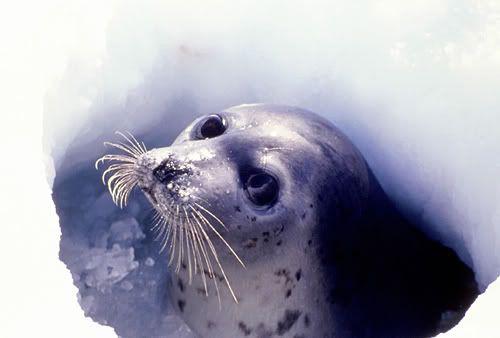
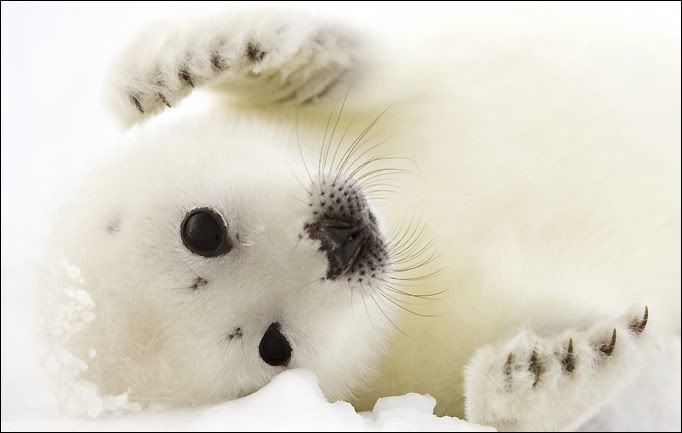
Harp seal pups are famous for their big black eyes and fluffy white fur. These are their trademarks in their first two weeks of life.
But these beautiful and gentle creatures have the unfortunate status of annually suffering the largest slaughter of any marine mammal species on the planet.
Every spring, great numbers of pregnant harp seals gather together on the stark ice floes off the Canadian Atlantic coastline of Newfoundland and Labrador and in the Gulf of St. Lawrence to the east of Quebec to give birth to their babies.
Commonly referred to as whitecoats, these famous babies are astounding in their innocence, individuality, and beauty. Their images have been captured in a thousand ways and distributed around the world, making them the most recognizable and well known of nature's innocent and precious creatures. It is ironic and sad that all this recognition does nothing to help their plight as these seal pups are the victims of a brutal annual massacre in a politically-driven, propaganda-supported slaughter.
Every year, when the time is "right" (as soon as the ice conditions permit and the seal pups start shedding their fuzzy white coats), about 2,000 to 6,000 Canadian fishermen (most of European descent and most living in Newfoundland and the Magdalen Islands of Quebec), find their way to the floes and proceed to club, bludgeon, shoot, and skin hundreds of thousands of harp seals, most just a few weeks to a few months old.
The Harsh Reality of the 'Hunt'
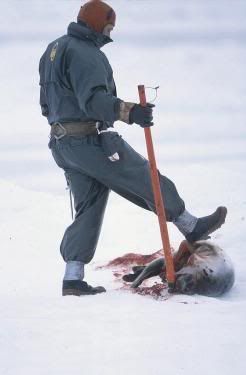
Today's modern seal "hunt"
isn't really much of a hunt at all...
Depending on the condition of the ice flows, the sealers can have varying degrees of difficulty in getting to the seals. Methods include: walking from their trucks, driving up to them with their snowmobiles, taking commercial icebreaking boats to distant ice flows, then getting out of the boats and walking to them, or shooting seals from the larger ships or smaller boats. Canadian Coast Guard Icebreaker ships often locate seal herds and shepherd sealers to them by breaking a path through the ice for them. Aerial reconnaissance is also used to locate the seals.
Once they find the seals, the true horrific nature of this bizarre event unfolds. In the first phase of the hunt (in the Gulf of St. Lawrence, dominated by sealers from the Magdalen Islands of Quebec), sealers typically approach the seals and then club them with 'hakapiks' (long sticks with a hooked blade at one end). After clubbing the seals, they are supposed to perform the 'blinking-eye' test, checking whether the seals blink, before skinning them. If the seal is not dead, sealers may dispatch the seal with a variety of methods, including kicking in the face and/ or continuing to beat the seal pups on the head with the hakapiks. The sealer may move on to other seals before skinning them or may skin them at that time. He will drag the seal to the boat with the hook end of the hakapik. If the sealer did not bother to check whether the seal was dead, the seal may conscious when the hooked blade is plunged into its mouth or head. An analysis by a panel of veterinarians showed that about 40% of the seals are actually skinned alive.
In the second phase of the seal hunt, on the Front, in the waters off Newfoundland and Labrador, seals are more mobile and able to swim, so sealers (mostly Newfoundland fishermen) typically shoot them from their boats. They aim for the head to avoid damaging the pelt. If they miss and wound the seal, they may get out of the boat and club the seal, unless the seal gets away into the water. In that case, the seal likely dies in the water and may never be recovered (or counted towards the quota). Sealers retrieve the seals with hooks, e.g., the hooked end of the hakapik, so if the seal was not killed by the bullet, it may be conscious when the hook is plunged into its mouth and it is dragged on the boat.
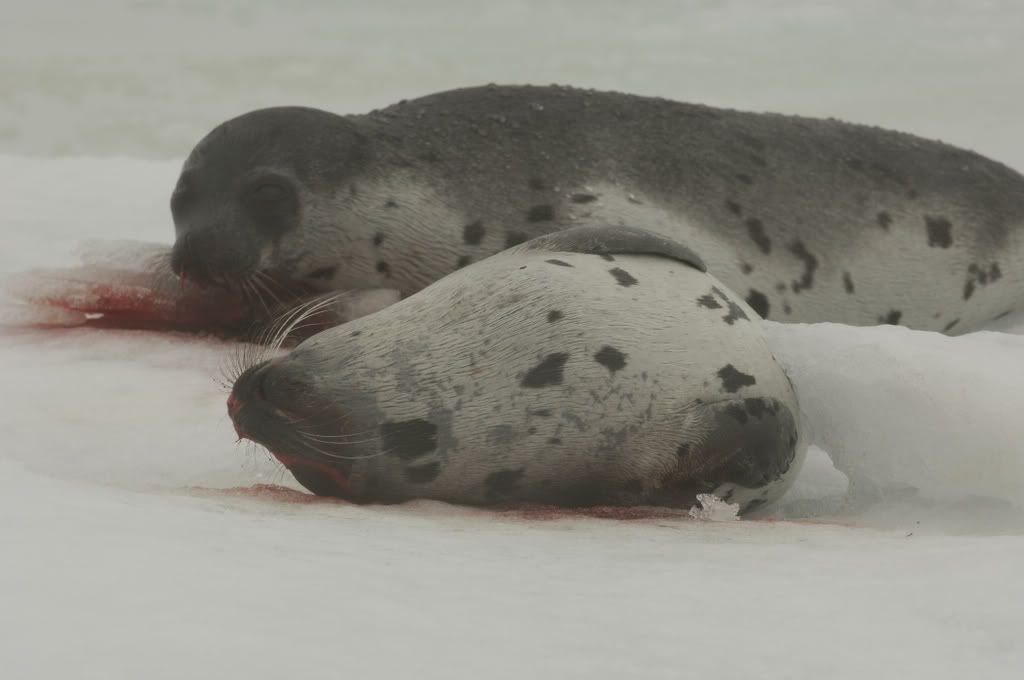
Adults and resisting mothers may be shot and/ or clubbed and skinned and in the case of males, may have their penis bones removed. (Typically the penis bones are harvested from adult males). If convenient to do so, some of the bodies are recovered and processed into pet food or used to feed the animals in fur farms (though this is rare). About 95% of the seals killed in the commercial seal 'hunt' are no more than 3 months old.
In 2008, Canada's Department of Fisheries and Oceans (DFO), set new standards for sealers to follow when killing seals. In addition to the blinking-eye test, the DFO now instructs sealers to palpate the seal's skull to assess whether it has been fatally crushed before proceeding to skin the seal. If the skull does not seem to have such a fatal wound, sealers are supposed to sever the main artery. In order to instruct sealers on the new standards, the Canadian Sealers Association sent individuals around Newfoundland with an instructional video a few weeks before the start of the hunt.
Each year, sealers kill about 1/3 of the pups born. This number does not include those seals that slip away wounded into the ice holes and sea leads. The seals killed by Canadian sealers must also be added to the natural (and human-driven) mortality. As global warming makes the ice floes less reliable, this mortality is on the rise.
IFAW Seal Hunt 2008 - The Hunt Starts - GRAPHIC FOOTAGE
How You Can Help
Canadian Seafood Boycott
The Canadian sealers are fishermen. Sealing is an off-season activity for them, a way to earn a few bucks before the start of the fishing season. Since seal fur and other seal products are illegal in the U.S (thanks to the Marine Mammal Protection Act), Americans can't boycott the seal pelts. But these fishermen sell their seafood to Americans. The Canadian seafood boycott allows us to pressure sealers to stop killing seals - or risk losing their main source of income.
What Seafood is Being Boycotted?
All Canadian seafood is being boycotted, but seafood from Atlantic Canada, where the seal hunt takes place, is a special focus. Below, we list common species caught by Canadian fishermen.
Please also consider avoiding all seafood as the best way to help the ocean ecosystems recover from decades of industrial-scale fishing that is jeopardizing the future of seals and all other marine mammals that depend on fish for their survival.
Common seafood from Atlantic Canada:
**Atlantic Halibut **Cod Cold-water
**Shrimp (i.e., cocktail shrimp) **Flounder (Plaice)
**Haddock **Hake (Silver, White) **Herring
**Lobster **Mackerel **Mussels **Ocean perch
**Pollock **Prawns
**Sardines **Scallops **Snow crab **Sole
**SwordfishTuna (Yellowfin, Bigeye, Bluefin)
**Turbot (Greenland halibut)
Common seafood from Pacific Canada:
**Alaskan Pollock **Canary Rockfish **Dungeness Crab **Geoduck clams **Hard-shell clams **Horse clams **Lemon Sole **Lingcod Pacific Cod **Pacific Hake **Pacific Halibut **Pacific Herring **Pacific Ocean Perch **Pacific Oysters **Pacific Red Snapper **Pink cold-water shrimp **Sablefish **Salmon (Chinook, Chum, Coho, Pink, Sockeye) **Silvergrey Rockfish **Rock Sole
Seafood sold in grocery stores should have Country of Origin Labels (according to COOL legislation in the U.S.), but there are exceptions to the law. Seafood that is pre-cooked and sold at the fresh fish counter (e.g., snow crabs and shrimp) does not have to be labeled. Neither does seafood that is part of a meal (e.g., linguini with shrimp or clam sauce).
Seafood sold in restaurants does not have to be labeled, but sometimes the menu indicates the country of origin (e.g., Prince Edward Island Mussels, from Prince Edward Island, Canada).
I think the best way to make sure, is not not eat ANY seafood!
Another good reason to GO VEG!!
Efforts to Close Seal Pelt Markets
The European Union is now working on a complete ban of seal product imports.
Closing the markets to seal products is the best way to end the commercial seal hunt. With little hope of making money on seal pelts, sealers will not find much motivation for going out into the treacherous icy waters to find and kill seals. Unfortunately, seal pelts are sold around the world, including in Asia, where seal activism is weak. Consequently, the efforts to close the pelt markets can be expected to result in partial success at best.
Nevertheless, this important effort has been undertaken by many nations. The United States banned imports of seal products as well as products from other marine mammals in 1972, with the passage of the Marine Mammal Protection Act. Mexico, Germany, Belgium, and the Netherlands enacted bans on seal product imports recently. (In the case of Mexico, this extended to all marine mammals and products from them.)
Most Canadian harp seal pelts are initially purchased by Norwegian companies, especially G.C. Reiber and Co. Norway is not a member of the European Union and would therefore not be directly affected by a total EU ban on seal imports. However, Norway does not provide the main market for the finished products (coats, boots, etc.). From Norway and other importing nations, the pelts or finished products are sold around Europe and Asia. Therefore a total ban on seal product imports into the EU (including Cape fur seal product imports), will deal a major blow to Norway's seal pelt industry due to the closing of the European Union market. This will not, however, eliminate European sales of seal products to non-EU-member nations, such as Russia and Ukraine.
Designers Who Use Seal Fur & Skin
Send a letter to these designers and politely request that they make their fashion more compassionate by adopting a permanent policy against the use of seal fur. (If you live in the United States and you send your letters to Italy or Denmark, postage will be 84 cents.)
Annika Heinadottir
Oehlenschlaegersgade 30
Copenhagen
Denmark
Phone: 45 26192611
Email: annika@dottir. dk
Birger Christensen
Ostergade 38
DK-1100 Copenhagen K
Denmark
Phone: 45 33 11 55 55
Fax: 45 33 93 21 35
Email: bc@birger-christensen. com
Gucci
685 Fifth Ave.
New York, NY 10022
212-750-5220
clientservice-europe@gucci. it
The Odette Leblanc Collection
022 de l'ecole Rd., Pointe-aux-Loups
Iles de la madeleine PQ. G4T 8B1
Canada
Phone: 418-969-9385
Email: oleblanc@tlb. sympatico. ca
Petit Nord OU
Marielundvej 28, 1
2730 Herlev, Copenhagen
Denmark
Phone: 45 44 85 20 50
Fax: 45 44 85 20 51
Email: Use the form at http://www. base-1. com/petit. html
Prada World Headquarters
Prada S.P.A.
Via Andrea Maffei, 2
Milan, Italy 20154
Phone: 39 02 54 67 01
Prada U.S.
610 W. 52nd St.
New York, NY 10019
Phone: 212 307 9300
Versace
Donatella Versace
Versace S.P.A. Headquarters
Via Manzoni, 38
Milan, Italy 20121
Phone: 39 02 76 09 31
Fax: 39 02 76 00 41 22
List Updated Dec. 15, 2008
Canadian Tourism Boycott
By boycotting tourism to Canada, especially to Newfoundland and the Magdalen Islands of Quebec, seal hunt opponents can pressure sealers and their supporters to change their stance on the seal hunt.
Those who oppose the seal hunt should let the Canadian government, Canadian tourist agencies, and operators of tourist establishments in Canada know that you are boycotting Canadian tourism until the seal hunt is banned permanently.
Contact Canada's Minister of International Trade
Tell Canada's Minister of International Trade, David Emerson, that the seal hunt damages Canada's international reputation, and remind him that it has resulted in ongoing global boycotts of Canadian seafood and tourism.
Say that a hunt opposed by most Canadian citizens shouldn't be allowed to harm Canada's economy.
Minister of International Trade
Foreign Affairs and International Trade Canada
125 Sussex Drive
Ottawa, Ontario
Canada
K1A 0G2
613-992-7332
Fax: 613-996-8924
Email: emersd@parl. gc. ca
Contact Canada's Prime Minister
Prime Minister's Office
Right Honorable Stephen Harper
80 Wellington St.
Ottawa, Ontario, Canada K1A OA2
613-992-4211
Fax: 613-941-6900
Email: pm@pm. gc. ca or Harper. S@parl. gc. ca
Posted By: One Voice
Source: Harpseals. org
Labels: Druid, Morrigan, PolarBears, SAVETHEHALES, Seals, Shaman, Strays, Wiccan, Witch
posted by Druid Morrigan Conway | 11:01 AM
|
0 Comments
People! I need you sign and repost this very important petition! Don't let the US get in bed withe Japanese Whalers!! It only takes a minute ~ now do it!
Labels: antiwhalers, Druid, DruidMorrigan, Whales, Wicca, Wiccan, Witch
posted by Druid Morrigan Conway | 11:22 AM
|
0 Comments
posted by Druid Morrigan Conway | 5:42 PM
|
0 Comments

Labels: ConwayMucha, Druid, DruidMorrigan, Morrigan, Wicca, Wiccan, Witch
posted by Druid Morrigan Conway | 3:33 PM
|
0 Comments

Labels: AnimalRights, Druid, DruidMorrigan, Wiccan, Witch
posted by Druid Morrigan Conway | 2:22 AM
|
0 Comments